

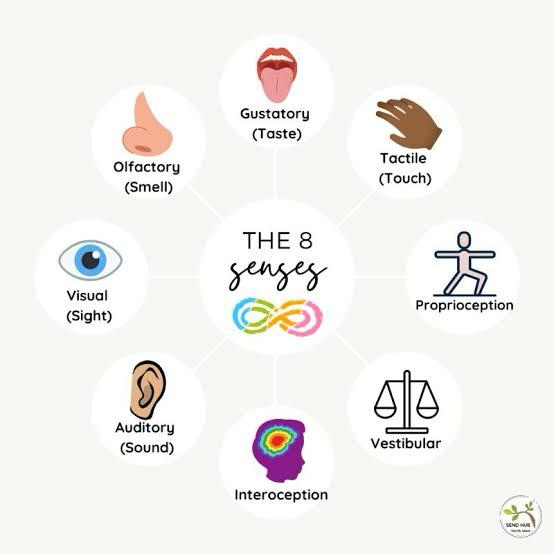
In sensory dysfunction person won't be able to receive information through senses and not able to organise the information and won't be able to use it to participate in everyday activities.
In sensory dysfunction brain has trouble receiving and responding to information that comes from senses. So, in this most affected part of the body which leads to sensory dysfunction is brain. It results from insufficient neurological processing.
Brain behaviour connection is very strong. Those who have sensory dysfunction has disorganised brain. So his behaviour will also be disorganised and his overall development is disorderly.
Behaviour problems are also present with a person with sensory integration dysfunction. Self-regulation problems occur. Person won't be able to calm down once aroused. They will perform unevenly.
Five most common senses are there.
There are 2 other less common types.
Tactile, vestibular and proprioceptive senses are fundamental. They lay ground movement for healthy development.
Tactile sense (Touch)
It is primary sense we use on a daily bases to process information from the environment.
It plays major part in determining physical, mental, emotional human behaviour. Every one of us from childhood need constant tactile stimulation to keep us organised and functioning.
We get tactile information through receptors located in our skin. Receptors identify the sensation of touch and gather information. The tactile senses are important for identifying pressure, vibration, movement, temperature, pain and texture.
We are always touching things around us actively or passively like we touch furniture, clothes, spoons, pen/pencils and touched by people. Even if we are not wearing clothes we are being touched by air and our feet touching ground.
Some areas of our body having more tactile receptors then other areas eg mouth, hands.
Tactile Dysfunction- It is the inefficient processing in the central nervous system of sensations perceived through the skin.
Children with tactile dysfunction feel certain sensations more strongly than most people do. Occupational therapist would usually call this tactile sensory issue as tactile defensiveness. Sometimes it is also called as over responsivity to touch. But the term means the same thing. It's not only experienced by children. It can be experienced by adult as well.
Someone who experiences tactile defensiveness will be more sensitive to touch. The person will react not only to actual touch but also to the anticipation of being touched. Most touch sensations will be uncomfortable and scary. Child will overreact with fight or flight response. Skin of these kids will be more sensitive to everyday things like clothes, hair brushing. They will say certain touch is painful. Children with touch sensitivity may show these symptoms.
Unlike the hypersensitive person who over react to protect himself the hyposensitive person may not react to touch effectively. He will be unaware of touch altogether unless touch is very sensitive. He needs extra stimulation. He may constantly touch objects and people.
Tactile training can be done by allowing child to do messy play with textures, playing with foamy soap or shaving cream. Sand for play, fingerprint, play with glitter, glue, slime, cake batter, cookie dough, playing with sand and asking child to make his own home, filling bin with beans, rice, pulses etc.
Vestibular sense
Vestibular sense contribute to our ability to maintain body balance and posture to perform any movement. This system takes sensory messages to the central nervous system for processing and then helps generate muscle tone that allows us to move smoothly and efficiently.
Receptor for vestibular sensations are in the inner ear 'vestibule' through which sensory messages pass. They register every movemnt we make and every change in head position even the most subtle. Movement and gravity stimulate these receptors. Gravity receptors serve the following functions.
To keep us upright
To provide sense of our motions so we can move easily.
To detect potentially threatening movement around us through vibration in the air
Vestibular dysfunction
It is the inefficient processing in the brain of sensations percieved through the inner ear.
Person with vestibular dysfunction is inefficient at integrating information about movement, gravity, balance and space. They may be oversensitive, undersensitive or both.
Person will be having balancing problems and he will be clumsy, uncoordinated and awkward.
Person may fall often. Eye movements are influenced by the vestibular system. In vestibular dysfunction kid may have
Vestibular training can be obtained by giving Vestibular input (sense of movement centred in the inner ear). Any type of movement will stimulate vestibular receptors but spinning, swinging, and hanging upside down provide the most intense, longest and lasting input.
Swinging may be front to side or side to side
spin will encourage child to spin at amusement parks or spin objects available in therapy sessions.
Proprioceptive sense
They include senses of position and movement of our limbs and trunk. Receptors for proprioceptive sense are in muscle, joints, ligaments, tendons and connective tissue. Stimuli for these receptors are movement and gravity.
Joint and muscle sensations that come through this system are closely connected to both tactile and vestibular systems. Because they are so inter-related.
Proprioception helps us with body expression, the ability to move our body parts efficiently, to run quickly, climb stairs, to carry suitcase, to sit, to stand, to stretch and to lie down. It gives emotional stability. We feel safe and secure.
Proprioceptive dysfunction
Inefficient processing of sensations perceived through muscle, joints, ligaments, tendons and connective tissue. As we know they are interlinked. They are accompanied by problems with tactile or vestibular systems.
Whereas it is common for a person to have only vestibular or any tactile problems. It is less likely for a person to have only proprioceptive problems.
So, if the proprioceptive sense is not receiving or interrupting input correctly within these muscles. Then kids will have some problems like
Inability to know how much pressure needed to complete task. Eg holding cup, holding pen/pencil.
These kids become easily frustrated as they tried very hard to perform any task are not able to do. They lose their self-confidence and become emotionally unstable.
They will be having following signs.
Proprioceptive training can be obtained by lifting, pushing, pulling objects, including own weight can stimulate proprioceptive by engaging in activities that push joints together like pushing something heavy or pull joints apart like hanging from monkey bar.
Dr Asma Kauser
PT (MPT, BPT, SI certified)
